

about
Lumafield helps engineering teams work at the speed of light. Lumafield's Voyager analysis software and Atlas AI co-pilot find answers quickly and facilitate collaboration. Lumafield's Neptune industrial CT scanner arms engineers with X-ray vision, allowing them to look inside their products, inspect invisible features, and pinpoint problems before they reach customers.
Scanner System
Lumafield
role
Visual Designer
team
2 Software Engineers, Design Lead, Visual Designer
YEAR
April - June 2023
project overview
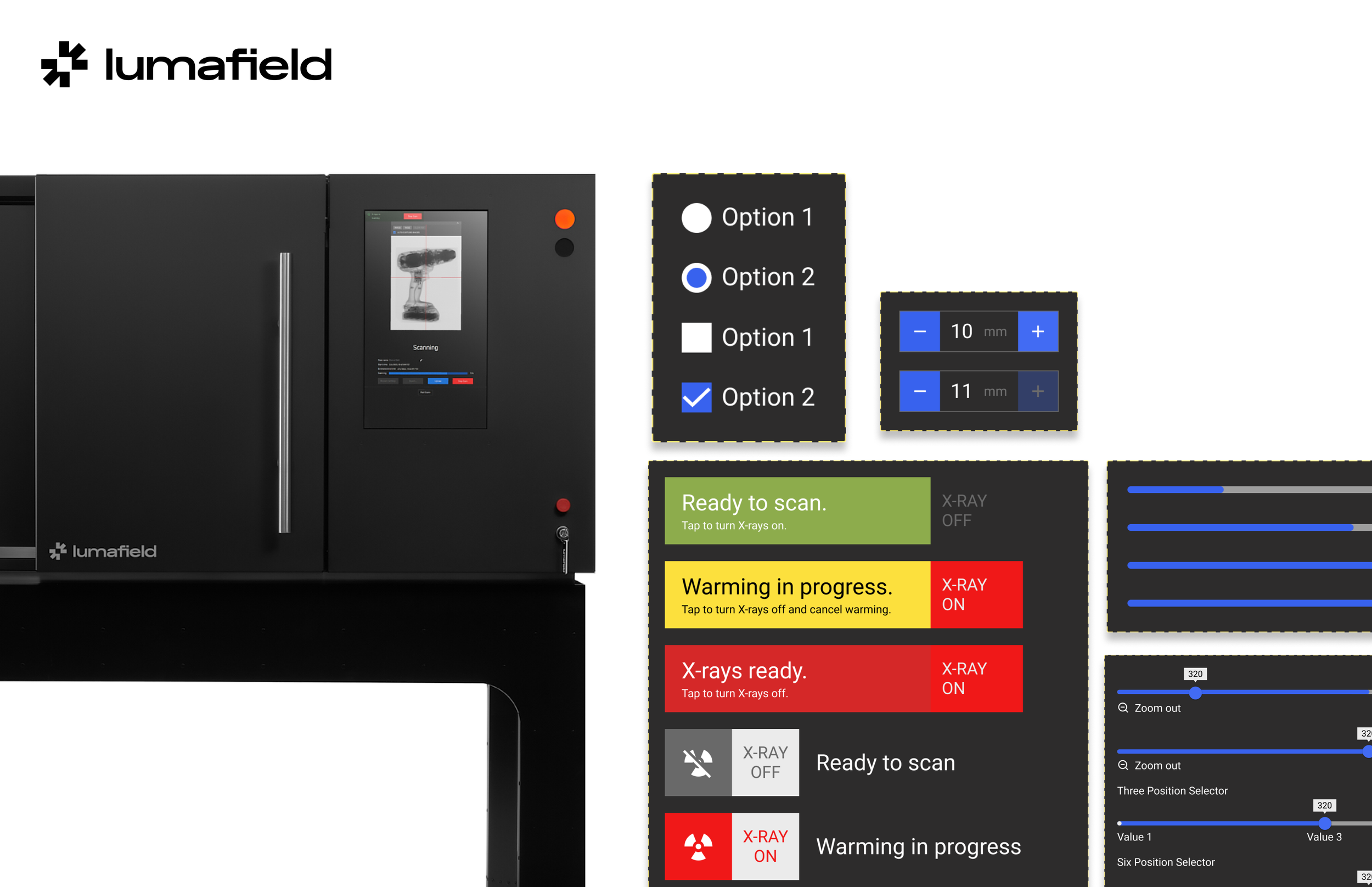
This project focused on creating a cohesive design system for Lumafield’s large-scale scanner touch interface. The existing interface lacked consistency across screens and components, making the system difficult to use for both operators and developers. The goal was to establish a structured, scalable design system that improved usability, streamlined development, and reinforced brand consistency across the scanner experience.
The scanner’s touch interface had evolved without a unified design framework. Over time, this led to:
Inconsistent indicator styles and visual patterns
Multiple button sizes and variants without standardization
Screens that differed significantly from one another in layout and interaction
Developers building UI assets from scratch with no baseline system
These inconsistencies created friction for users navigating the scanner and slowed development workflows. Operators experienced confusion moving from screen to screen, while developers lacked a reliable set of reusable components to work from.
Problem


Final deliverables are a UI kit and modular design system establishing a consistent set of design principles, patterns, and components that could be systematically applied across the entire user experience.
UI Kit

The result was a robust and adaptable design system that not only elevated the user experience of Neptune but also streamlined development processes, fostered design consistency, and reinforced Lumafield's brand identity as a leader in industrial CT scanning technology.

